Thursday, 5 February 2015

Intensive Care


Intensive Care is an interesting concept at UTH. The first time I set foot on there 18 months ago I was shocked by the lack of nurses, lack of sedation for patients (who were tied down lest they remove their breathing tubes), the lack of facilities, the lack of equipment, the lack of resources, the lack of oxygen, the lack of drugs, the lack of peace and quiet with the alarms blaring at every conceivable minute of the day… the list is endless, as were the problems…. My abiding memory is that the first 8 patinets I’d admitted there all died there. It was pretty demoralizing. I don’t think I’d ever had that many patients die in a month before.

  But this is now. The sign remains as a pretty stark reminder of what the general consensus of opinion was about going to ICU. But after 18 months when there has been a considerable increase in the input by anaesthesia – supplying an MMed trainee there on a daily basis in the week, and the institution of a daily consultant ward round. Things, surely, must be better.

Tell it how it is I guess!
Beware the fairy tale ending I guess, it was more like the Brother’s Grimm when I walked through with Dave on my first day back at UTH (Monday) where there were 3 nurses to look after 8 patients – ok, not the usual 1:1 ration, but still maybe a 1:2 ratio. But no, they were rooted in the same spot as they always were to be found – sitting at the desk, chatting and playing on their phones. Not a single nurse next to the patients and the alarms pinging wildly.

A typical example of the ICU - patients in the beds and no nurses to be seen... apart from the one sat by the main desk. But the floor is gleaming due to cobra polish!

Infection control is taken very seriously - see the note above the patient's bed 
One of the regular ICU 'admissions'
When we approached (bearing in mind Dave is a consultant on the ICU) and asked politely if one of them wouldn’t mind attending bed 4 – we were greeted with a brief raise of the eyebrows before normal business was resumed back into the phone screen. We were both astounded. Though it is interesting that when the hospital matron came striding in they got up off their chairs in unison like some sort of African Mexican wave as if they’d been scalded. It added a whole new dimension to ‘jump to it’. It seems that matron still wields some power but it seems that she only wields it as long as she and her starched uniform and hat are in the vicinity. They soon sat down when she left!


So Thursday I thought I would go and spend a whole day there lest that brief snapshot had coloured my experience. Within minutes of starting the ward round however there was a great cuffuffle as a patient was unceremoniously dumped on the bed. No prior warning or consultation. He was struggling to breathe and thrashing around wildly in a confused state.

Malaria life cycle for those interested in seeing how it spreads! 
  We gleaned that he had tested positive for malaria and that we was in his early 30’s . Now there are 4 types of malaria carried by mosquito’s. However in Zambia they only carry Falciparum – which is the worst type to get! So, he had signs of cerebral irritation (essentially the malaria had penetrated the brain) but his lungs were also full of fluid and he couldn’t breathe because the malaria had caused his kidneys to stop working and they were unable to excrete any urine and hence the build up of fluid were filling his lungs and constricting his heart.
  We treated the fluid in the lungs as best we could with a water tablet and some morphine. There wasn’t any nitrates in the hospital in any shape or form (to dilate the blood vessels to reduce the workload for the heart). He was too wild to tolerate a tight fitting mask blowing high pressure air into his lungs to keep them water free, to be honest he was too wild to be left without about four of us by the nedside making sure he didn’t roll off the bed such was his agitated state. So we were left with choice but to put him to sleep and take over his breathing that way. That at least was uneventful after the Mmed managed to clamp an oxygen mask over his face and hang onto it whilst he was lying on his front, naked with his bottom on show to everybody on the unit as he’d managed to completely disrobe himself by then.

 After intubating he seemed to stabilize so we sent blood tests to the laboratory, ordered an xray, wrote up his antimalarials and went back to start the ward round. However as we started back we noticed that the heart tracing (ECG monitor) was getting wider and wider – to the extent that it started to look as wide as my little finger. Uh –oh.

He looked like this when normally he should have a rhythm like the one below


This was likely to be his potassium levels being very high. So we treated those with calcium (an antidote) with insulin (that drives the potassium out of the blood stream into the cells of the body), we couldn’t use a nebulizer as that didn’t fit on the ventilator. At this point we still didn’t have blood results back. In fact we didn’t get them until 2 hours after we had sent them – pretty standard. They confirmed indeed that his potassium was high when we took them – 6.8 mmol/l (who knows what it was when we treated it 120 minutes later!), however his sodium was low at 106, chloride too and his creatinine was circa 2150. The reagent for urea was not working, but to be honest we didn’t really need that as it was likely to be high also! So imagine my surprise amongst the non-availability of key drugs like nitrates that Dave picked up the phone and spoke to the kidney doctor (who is also one of the co-opted ICU bosses now) and arranged for him to have kidney dialysis! Bonkers!

  HOWEVER, this is not as easy as it sounds…. Usually it means putting in a special line and then the machine is wheeled to the bedside and the patient is hooked up and away we go. Oh no, not here! There is a dialysis unit. It is however up a flight of stairs and the furthest end of the corridor away from the ICU. So cue ‘operation take patient to the dialysis unit’.

First you have to call the oxygen guy who turns up with a small bottle of oxygen for transport – one of only three little bottles in the hospital. Then ideally you wait until everything else – i.e. drugs and equipment is ready before you disconnect him straight from the ventilator on to a hand ventilating bag system…. Ideally. Here is seems you turn off the ventilator, then realize that the essential bit of kit i.e. the hand ventilation bag isn’t there, but now as you’ve turned off the ventilator and the oxygen cylinder there is a bit of a wait to get that turned back on again, meanwhile a nurse is slowly (I’m not sure she even reached first gear) walking to see if she can find the hand ventilating bag whilst the patient becomes bluer and bluer. You get the message! Anyway, eventually the bag is found and he is hooked up and all the normal parameters are restored.

MMed transferring patient using Lifebox monitoring en route (yellow box on patient's abdomen)
  I was curious to see the process of the transfer so went along to see. Firstly you have to travel down the concrete corridor using only the Lifebox pulseoximeter as your monitoring. A great, portable device that gives oxygen saturations and also the pulse and a reassuringly loud beeping tone which is saving thousands of lives throughout the world, but its not so great when its in the direct sunlight of the corridor when you can’t actually read the screen – so we were very thankful for the beeping noises. However I discovered another useful purpose of the pulseoximeter when we eventually got to the only working lift in the hospital – it provides a sliver of light – which is a darn sight more than the total pitch darkness that we were plunged into as the lift doors shut and we ascended up a floor. Thankfully we made it to the top and weren’t stuck in a total blackout!

Getting into the lift
 Anyway the next step was a bit of a workout, pushing the bed up a slope was about to commence with some repetitive stops to lift the trolley over the gaping holes in the concrete joins. It was like circuit training just with higher stakes.
Uphill pushing
 But then lo and behold we arrive at the dialysis unit! We are directed to bed number 10. It seems you are not allowed to come to the unit unless you have been tested for hepatitis B or RVD (retroviral disease/HIV). It seems that we were positive for Hep B but negative for RVD so we had to go to the specific machine. They keep this system to prevent any miniscule chance of contamination and spread- it seems to work well. I was amazed to look around and counted at least 8 people there on dialysis. Three of which were children. Apparently they can dialyse up to 14 people in the morning and another 14 in the afternoon. This is great and I’m sure life saving/prolonging to many people.
Plugged into the dialysis machine
  And it looked like it would be plain sailing once we got there. The staff seemed to be very competent and were busy sorting the machine out… except of course it takes time to get the machines set up during which of course his potassium level had started to climb again as was evident from the changing ECG pattern again. To the extent that the ECG was now so incredibly wide and he was having runs of VT (specific heart rhythms that can well pre-date cardiac arrest).  

Thankfully another dose of Calcium slowed them down. My very bright MMed trainee enquired politely where the defibrillator was – in case we did have a cardiac arrest – good thinking. I mean most people with failing kidneys i.e. all of the people that were in the unit have a high likelihood of having high potassium and also potentially heart disease and a defibrillator is often handy in these settings. However we got quizzical looks until we explained it was the heart machine that delivers electric shock – you know like on the telly? It was eventually the obligatory actions of somebody holding two charged paddles and giving an electric shock. That made the penny drop. “Ahhhh, yes..”At last I thought, we are getting somewhere, “yes, we don’t have one”. Oh, said I – do you know where I can get one then please. “Oh yes – main ICU”! Where we had come from! There seems to be only one there and one or two in theatres and that is that. If you have a cardiac arrest on the ward and need an electrical shock I can only presume you either don’t get one at all and you die or your relatives have to be quick at unwiring a nearby plug and trying their hand at DIY defibrillation. 

Anyway we were saved the trouble of fetching it as we got him on the machine and the potassium clearly came down as the heart rhythm went back to normal. He was there for 2 hours before the journey back was commenced – thankfully without a glitch.
  Which is just as well as there were another 7 patients on the ward too. One of which was incredibly sad - he was known as Unknown male. 

He had been in the hospital for 10 days total, 5 of these in intensive care after being found by the police by the side of the road - presumed road traffic accident. Imagine being in hospital for 10 days and nobody knowing your name or who you are. And no family or friends visiting, or maybe even knowing he's in hospital - very sad and sobering.

Anyway after having recurrent fits on the ward they eventually transferred him to ICU who then got a CT head done (this involved transferring him across town to the military hospital as none of the scanners in UTH or in the cancer disease hospital across the carpark that we used to use, function anymore). The CT showed catastrophic brain injuries which cannot be operated on, but as we have him on a ventilator there seems to be a real reluctance to stop ventilating people here. So he remains on the ventilator - a futile exercise for him, nurses and staff. No wonder the nurses have low morale if they care for dead or dying patients all the time. There is a move to try and rationalise these head injury admissions because if there is really nothing we can do then it seems a waste of resources to populate the unit with people who are ventilated until they catch a pneumonia and die. But I'm not holding my breath that this will happen soon.

Wednesday, 4 February 2015

ZEST


I was very excited to come back to see how ZEST: Zambian Emergency Simulation Training was going. Simulation is a mode of teaching we use a lot in anaesthetics and medical education in the UK but its a fairly new concept in Zambia. It was first set up by David and myself as a vital means to teach MMed students about emergency clinical situations (some that don't occur that often in practise) which they might face but in a safe environment.

The name was basically derived as an acronym however it also doubles up as the ZEST of a lime - a refreshing twist on medical education. Not to be confused as a lemon... we wouldn't want people thinking we were calling them lemons!

 So we first conceived the idea as we stumbled upon a pretty well stocked up medical students simulation room in the University across the road and with  a little negotiation we got the go ahead to hold a sim session there monthly. This was great and certainly kick started our sessions of a simulation scenario followed by a consolidation lecture/presentation.

Simulation lecture in old simulation classroom

Simulation scenario with the then 3rd year MMeds in old simulation classroom
However there were limitations to this as it was in the simulation room it didn't feel all that real and we wanted to recreate the feeling of being in theatre and also develop skills such as situational awareness and interdisciplinary working. This was hampered by us not being allowed to take the mannequins from the room across to the theatre setting.

 Since I've left things have blossomed. After holding the SAFE Obstetrics course the simulation mannequins have been left in UTH awaiting the next course but they have very kindly allowed us to use them meanwhile to teach the MMeds as a part of ZEST. So the sessions are now held in theatres and are definitely far more real time.

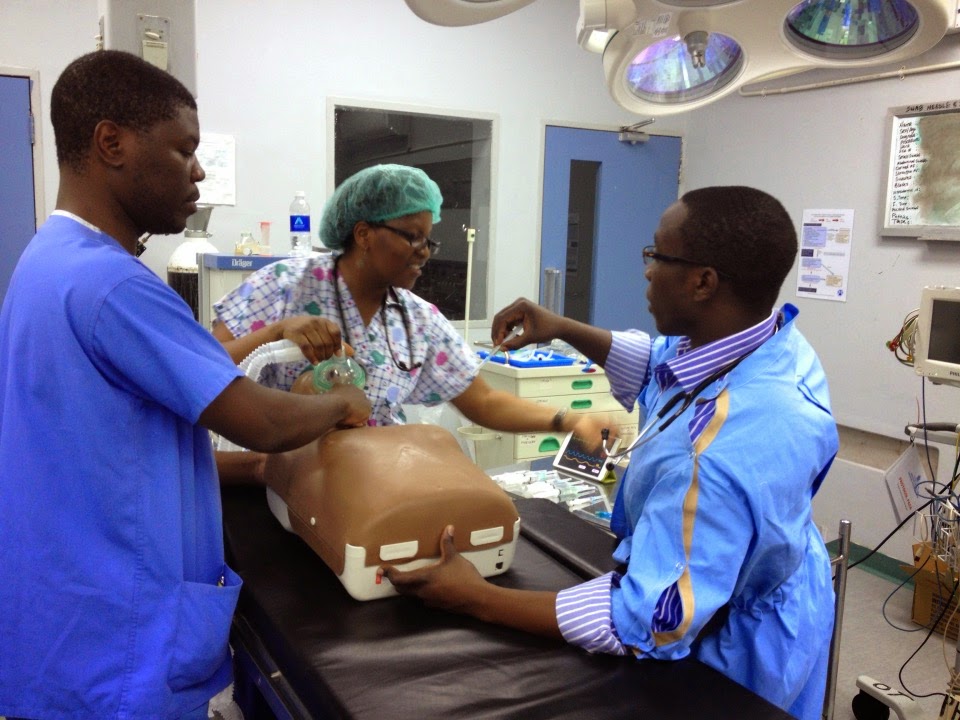
Simulation set up with ipad as a monitor and equipment and syringes out as per usual set up


Its amazing how you can recreate the anaesthetic monitor from an app on the mobile phone and control the display from it on the ipad via blue tooth! In fact we can even supply the MMeds with carbon dioxide monitoring (which we have yet to get in real life out here) so that they at least get to become familiar with it for when they do.


Giving a patient (ok, well a torso) some oxygen before starting the process of intubation
Mid intubation

Its great fun to teach. It does involve a bit of preparation work - both writing the scenarios to run and also setting up the theatre to make it more 'real'. However the Zambians are born actors. They are absolutely fantastic at role play and have no qualms whatsoever in standing up and doing this straight off the bat - which is in contrast to many trainees in the Uk from my observation who are certainly more shy about a thespian performance! Some of their mimicing of fellow colleagues/allied health professional are so real it makes one half believe that they are actually in the room themselves!

Having successfully intubated, considering the further options

A part of this is certainly cultural and I have also been told (and I am inclined to think there is some truth in it) it is also linked to their strong faith and attendances at Church every Sunday where they often have to get up and perform/present or hold a discussion group. Vital skills for public speaking and simulation learning it seems. Something I think I could certainly learn from.

 So this week was a difficult case of asthma which didn't get better despite maximal treatment and needed to have an anaesthetic to go to intensive care unit. It involved not only timely identification of the problem but also the management steps and also the logistical steps of what to do and more importantly how to do it out here (like setting up a nebuliser - most had no idea - again I suspect there would be a few red faces in the Uk at this request!) The other was a young lad who was undergoing a fixation of his leg and ended up getting a fat embolus. The good news about all of these is that we can manipulate and control all the vital parameters and if the trainees intervene appropriately the patient can improve, if they dont act in a timely fashion there is deterioration - so it really is a great way to teach thinking and doing under stress!

  I'm hoping to do quite a few more of these sessions whilst I'm here as they are not only of great benefit to the trainees but they are immensely good fun to teach! And certainly a breath of fresh air from a warm lecture room!

The future plans and aspirations will be to try and get some multidisciplinary sessions developed - be that with theatre nursing and porter staff or allied surgical specialties. This way team working especially in times of crisis will be well attended to. Watch this space, who said you cant have your cake and eat it?!


Tuesday, 3 February 2015

Tuesday: Obstetrics


The UN Millennium Goals were devised in order to try and tackle some of the really pressing problems occurring in the middle/lower income countries. 

One of the eight which anaesthesia is very much a part of is goal number 4: Reducing child mortality and 5: Improving Maternal Health.


                                    http://www.un.org/millenniumgoals/maternal.shtml

The MMed programme and ZADP programme has been key in helping set up, run and teach the SAFE Obstetric courses (the third one is due next week) alongside Zambian MMed trainees who will become the teachers of the future and will continue to run the courses long after us ‘foreigners’ have left! This teaching is key to the on-going safety of anaesthesia to pregnant women and reducing maternal and neonatal deaths especially out in the rural areas of Zambia where the only anaesthetist might be a non-docotor, non-nurse practitioner. Which is just as well as currently the Neonatal Mortality Rate is 34 per 1,000 live births (compared with 4 per 1,000 in the UK) and the Maternal Mortality Rate is 591 per 100,000 live births (12 per 100,000 in the UK)


Helping with teaching with the MMed trainee Hazel at the first SAFE Obstetrics course
  However the courses are a total team effort but are totally indebted to the sweat, blood and tears of one key man in particular: Dr David Snell, who is in his second year out here running the Zambian end of the Mmed programme on behalf of Prof Kinnear in Southend. David and I started at UTH on the same day and we laughed, cried, shared frustrations and successes over a six month period when I was last out here.  However he and his wife Kaly (who is also making strides with palliative care out here) and two boys have made the amazing commitment to staying here for two years which has brought great continuity of care to the programme and they will be really missed when they leave in July.  A truly selfless couple.

So the SAFE Obstetrics course is going strong, and long may that continue but what is currently interesting to me right now is how are we doing at UTH? So, Tuesday saw me mosey on down to the Obstetrics theatres to see what was what!

Not too much has changed:

Porter folding'sterile' swabs
The nurses and porters are still busy washing and folding the linen to be used as sterile drapes as well as folding the swabs neatly into piles before they get sterilized – which is why often, there is a shortage of swabs or drapes at the end of the week. And often why there is such an infuriatingly long wait for the patient to arrive if the porter is busy folding swabs!
  
Folding 'sterile' linen in the corridor


 The patients relatives also still do their washing and hang the colourful chitengi outside to dry when the rains stop. And inside the airway equipment is still reused and soaked in a bucket full of chlorine to disinfect before they are scrubbed and reused on the next patient due to poor resources. 


The recovery is still too small. It has the capacity really for one person though it usually has two women in there side by side being momitored just with the use of one pulse oximeter donated by Lifebox (which I am sure I will talk about in later blogs – but basically a machine that reads the oxygen levels in the blood and gives the pulse rate too, which is really the very least amount of monitoring you’d expect after an caesarian section. 

Recovery room
 But the surgeons are very quick – they have to be when you see that there is a board full of names of people that need urgent operations and only one theatre….
4 names on the board indicating two women that are failing to progress well in their labour (one lot are twins) which generally means by the time they come to theatre there is foetal distress. There is another that has documented foetal distress - basically the baby's heart was very low and then another who needs a caesarian because of a large baby secondary to the mother having diabetes of pregnancy (but also having pre-eclampsia too)... A board of women that would be fairly urgent to do back home - likely to have to wait a few hours here...


But other things have changed for the better: 

We now actually have not only 2 and 5ml syringes but also 10 and 20ml syringes which makes drawing up drugs so much easier. There is a dedicated cupboard for the storage of equipment for anaesthesia in the back of the neonatal resuscitation room (started my colleague Rachel who followed me in the ZADP programme and consolidated by Emily – the current ZADP registrar). This makes restocking and getting and finding stuff in an emergency so much easier. The Mmeds are working really hard and are making good decisions of when to operate and when they need to ask for different tests to be done/blood to be brought before they start. All of which is certainly contributing to safer maternal health. And also my colleague Emily has recently been involved with some of the MMeds and also the Obstetric team in a multidisciplinary approach to writing new guidelines for pre-eclmapsia and major obstetric haemorrhage.  All great strides for improving the service offered to mothers at UTH.


Anaesthetic storage area in the neonatal resuscitation room
  
However my day was pretty eventful as would be expected. Two very urgent cases with the first one a placenta praveia which was severe and likely to bleed a lot – sporting to say the least when there is only 1 unit of blood available to transfuse in the event of a major haemorrhage.  Thankfully the surgeons were incredibly swift in their operating and the blood loss was minimal – still it would have been good (and less stressful) to have had a few more units at the ready.


 The second was an extremely urgent case due to foetal heart rate being very low. In fact it was so low when the baby was born that she needed resuscitation. The midwife recognized this very quickly and thankfully asked for help early, so it was a good opportunity to show and talk through and teach some neonatal resuscitation as my fellow MMed trainee was looking after the mother. Luckily for us the baby was resuscitated with some rescue breaths (5 big breaths to open the lungs) and some help with her breathing until she decided that she was going to join the party and do it herself! I’ve never been so relieved as unfortunately here the special baby care does not have the ability to ventilate little babies like this and even if I had placed a breathing tube  (if she’d needed it) unless her relatives sat by her bed and breathed for her pressing the bag she wouldn’t be able to survive.


 And her survival instincts must be high as after we had managed to resuscitate the baby I returned to the operating theatre to check on the mum and left her in the capable hands of the midwife (or so I thought!). On wandering out a bit later I found the baby lying – swaddled in the thickest of blankets in the heat of the day (30C!) with oxygen propped up against her via a ventilating bag. No sign of the midwife anywhere, but at least I guess the baby was kept warm and that she had considered the use of some oxygen, despite its delivery method not really working! However the good news is that the mothers and babies of both cases did well and went home two days later.

 So all in all I think that there are some very positive aspects coming from the Obstetrics theatres. There are many that need further input and others that are still frustratingly difficult to change. But I do see that we are making progress even if it is pangono, pangono…. Slowly slowly (Nyanga!)

Monday, 2 February 2015

First week: Monday

Any first week should surely be one of easing in gently. Surveying what's going on and where I can fit in. Well, that was my plan initially! And my first week back was a full week of clinical stuff - back with a bang so to speak, but actually probably the best way to get 'up to speed' with things again.
 
My plan had been to cruise round the different theatre complexes (there are 4):

  • Main - which has 8 theatres in total but not really running more than 4 a day
  • Paediatrics - 3 theatres - all running daily
  • Obs and Gynae - 3 Gynae theatres (but only 2 running) and 1 Obstetrics
  • Emergency - 3 theatres - variable running!
  And of course I couldn't forget or leave out the Intensive Care Unit - which was somewhere I was really keen to have a look and see what had happened in my absence.

Monday:

  I decided I'd ease back into Zambian anaesthetic life gently by going to main theatre. I don't know whether if it was post election blues or not but the productivity was pretty low. In fact despite four theatres being prepared and full of anaesthetic Mmed (trainees)there was only a total of 5 operations carried out throughout the whole day. Two of which were in my theatre!
  I was starkly reminded of some of the problems here with delayed healthcare with the first case. A victim of a road traffic accident (very common due to poor infrastructure and  vehicle condition).

  He basically arrived with a broken leg. Well, ok I am slightly underplaying it. There is broken and there is properly broken beyond all belief. He clearly falls into the latter. If you look closely you can see where the skin is tented from the femur overlying the fracture.


 Of course in the UK we would be keen to fix this (in a 23 year old bloke) as soon as possible. Hmmmm.... 5 months after the initial injury he arrives in theatre to have a plate placed so that he is able to weight bear. He will never play football or run to the bus properly ever again, but at least he will manage (hopefully) to use the leg and not have it amputated.

 And credit where credit is due the surgeon did a fantastic job and managed to do this without too much blood being lost and also it was about a 2.5hour procedure which to be fair seemed fairly swift, and the spinal anaesthetic lasted all that time!
  For me the major plus point of being in theatre was being witness to the third year MMed (3rd year of 4 of training) actually teaching a first year MMed how to put in a spinal anaesthetic (an injection of local anaesthetic into the spinal fluid). A definite progression from the last time I was here as the MMeds are taking on the responsibilities of teaching their more junior trainees which can only bode incredibly well for their future as consultants. And is a huge plus in the quest for sustainable healthcare and education.


And above are the pictures of the antiseptic technique and then the close supervision and teaching of a first year MMed placing a successful spinal anaesthetic being supervised by a third year.  Brilliant!

  For the sharp eyes amongst you - you will notice  we did not use any drapes-correct: there are no drapes!
Positioning is not so easy when there is no ODP, a thin unmoving bed - so straight legged spinal application is a trickier affair than first appears!

 However the really good point is that the spinal packs are created by the theatre porters and these are definitely being created more often than they were when I was last here. Secondly the needles used for the procedure are purpose built spinal needles - not a 'make do' intravenous alternative. However the 22Gauge is still a rather large needle compared with the 24 or 25G we normally use in the UK - the risk of headache is definitely worse. But still - this is great progress.

  SO, Monday, the start of the week was pretty positive indeed. Onwards and upwards....